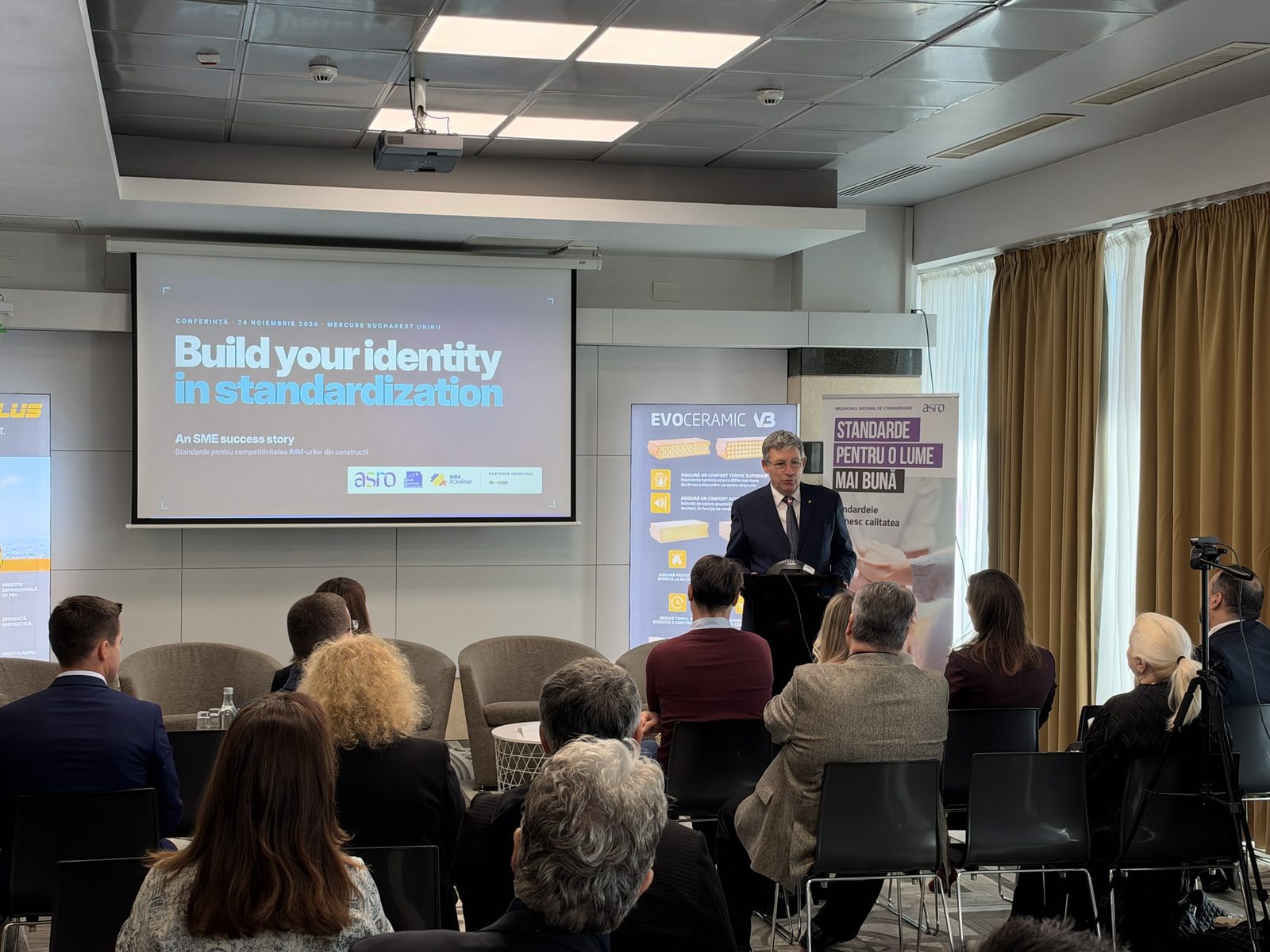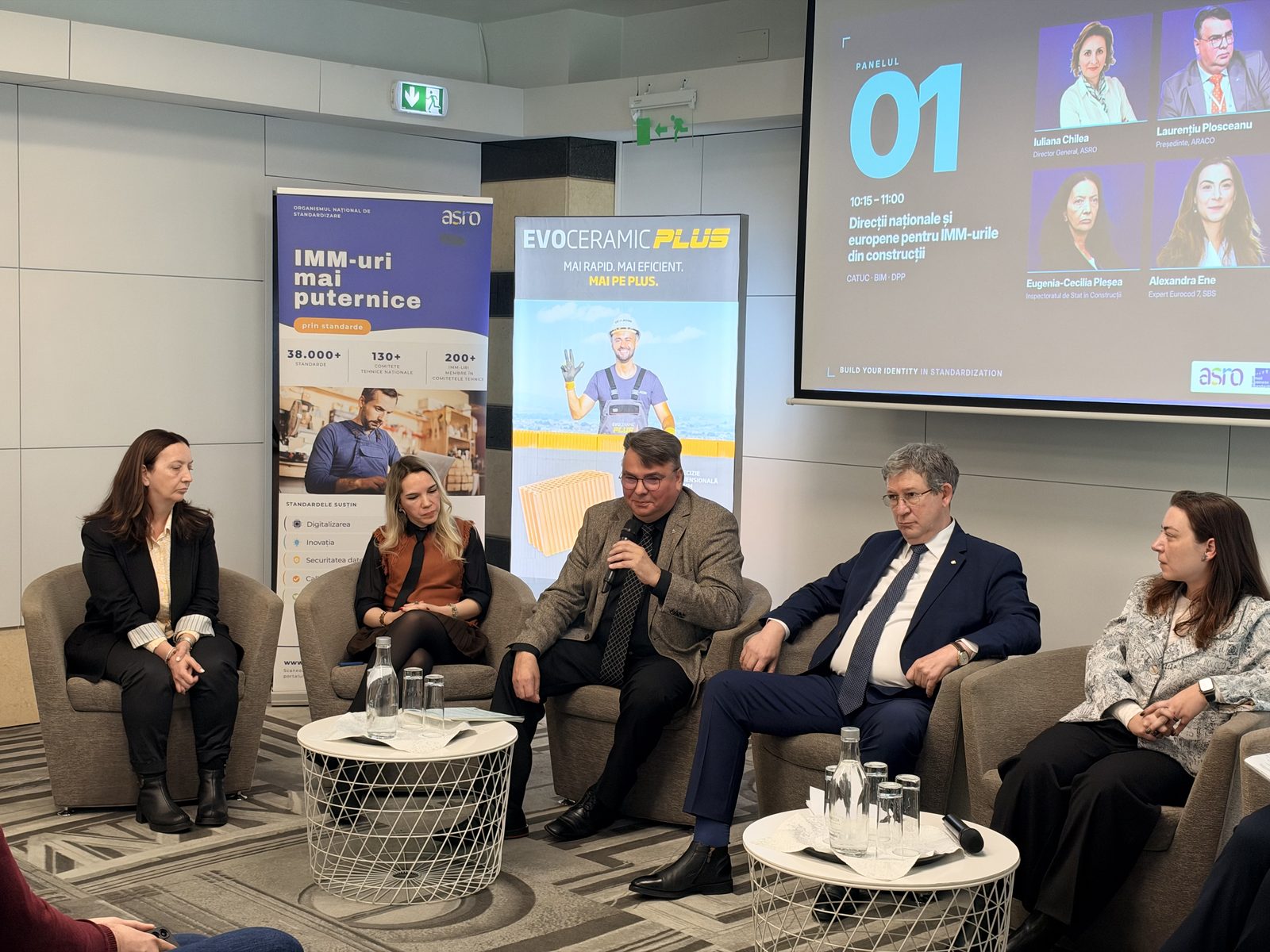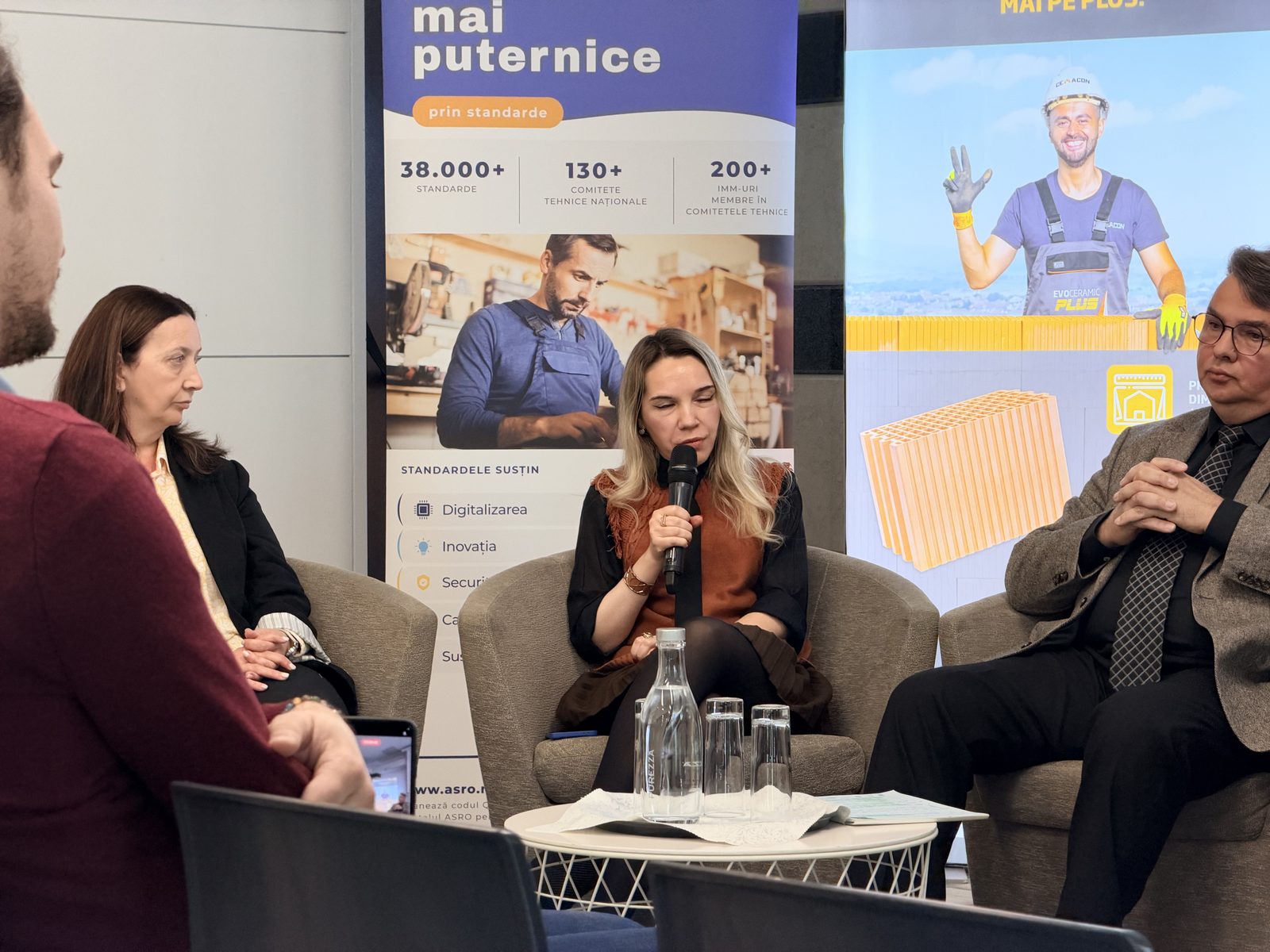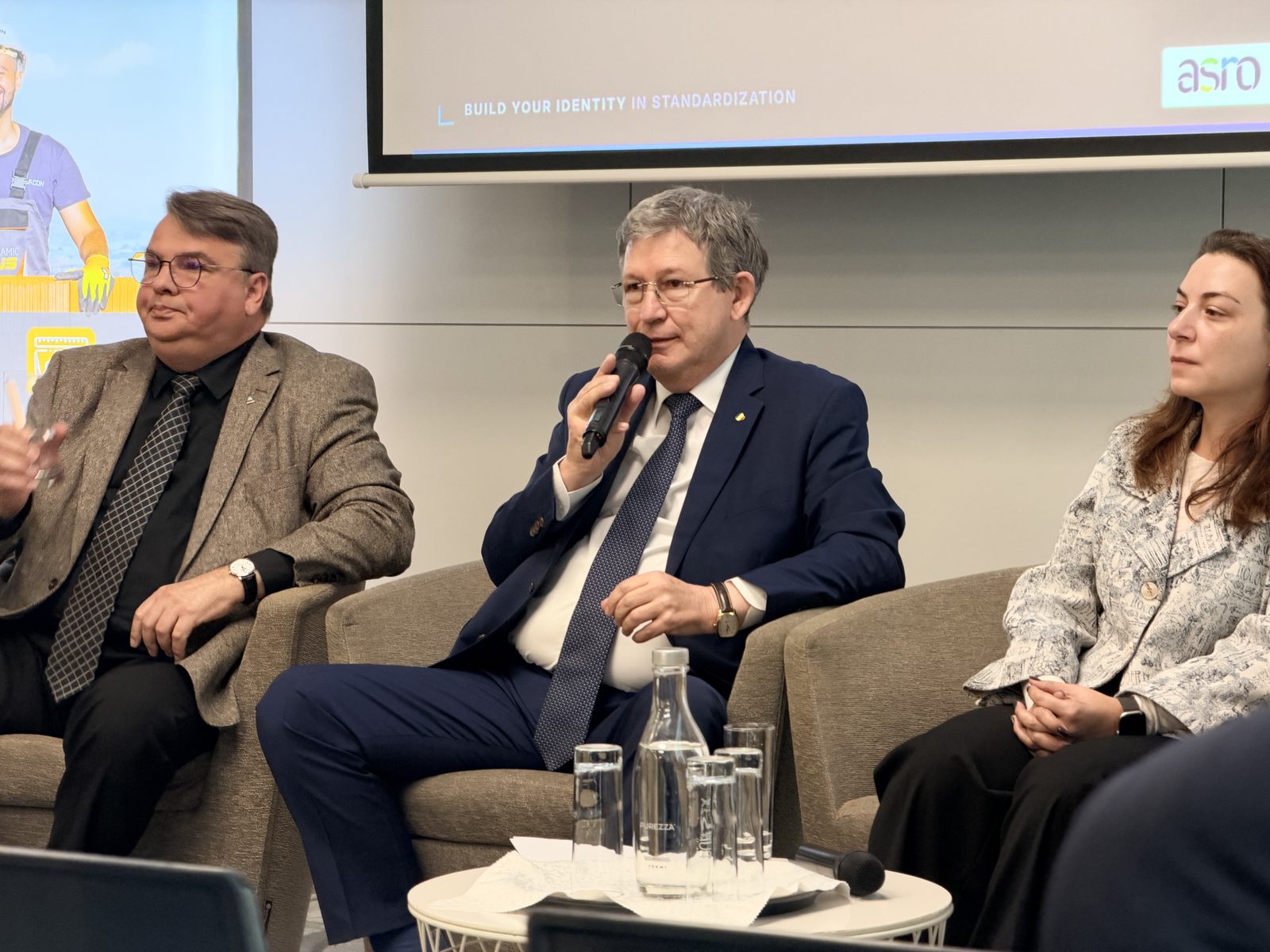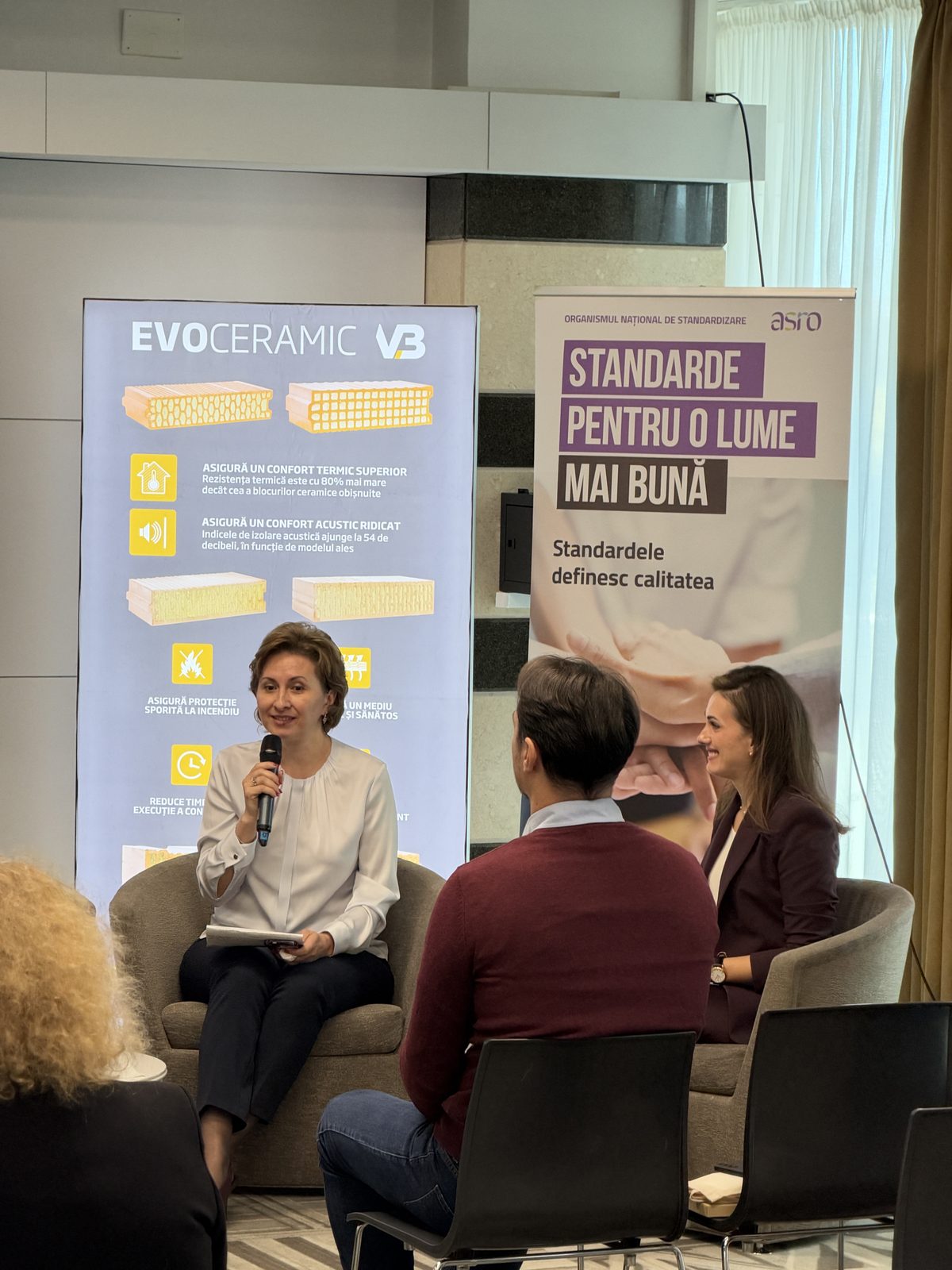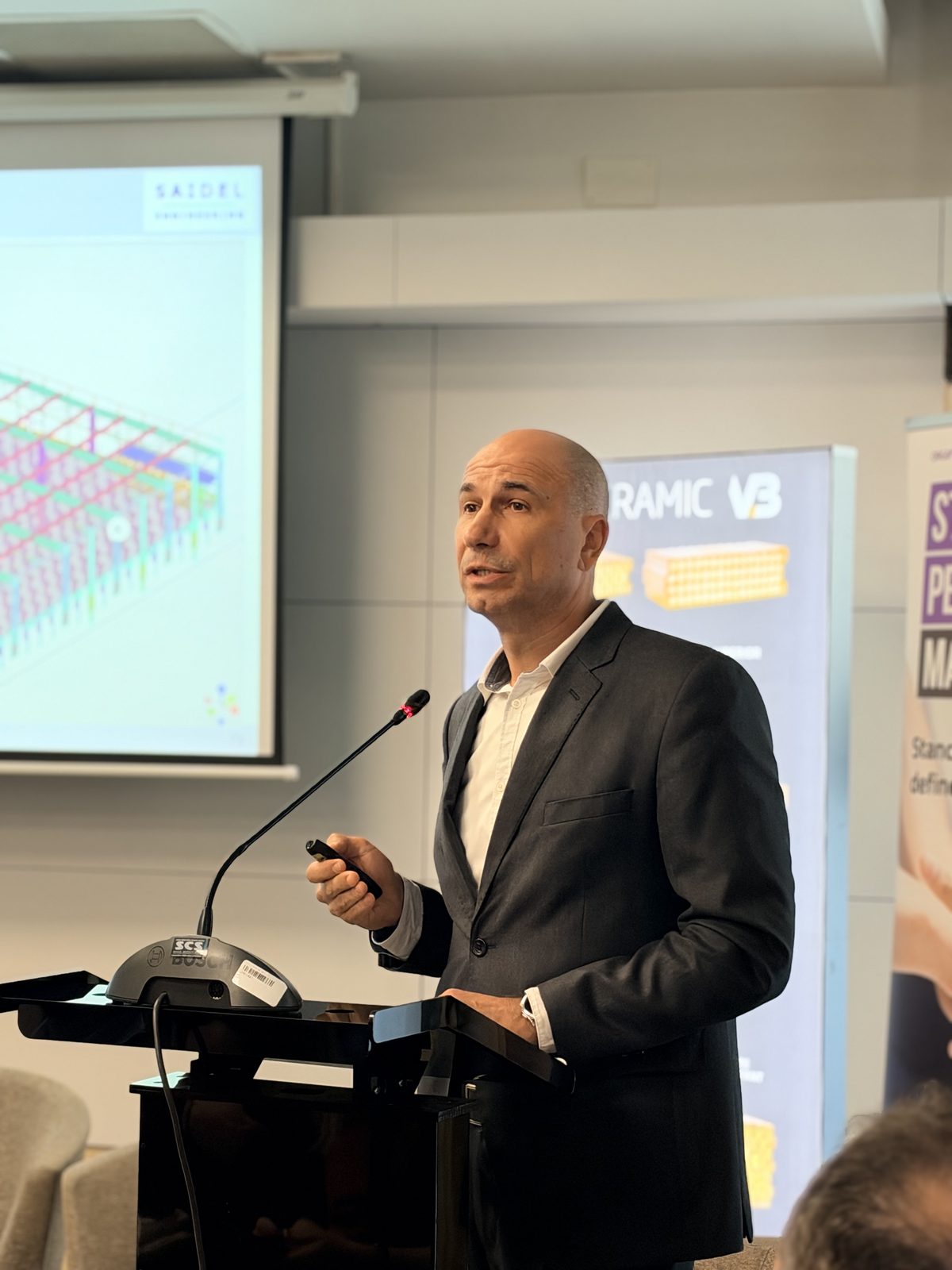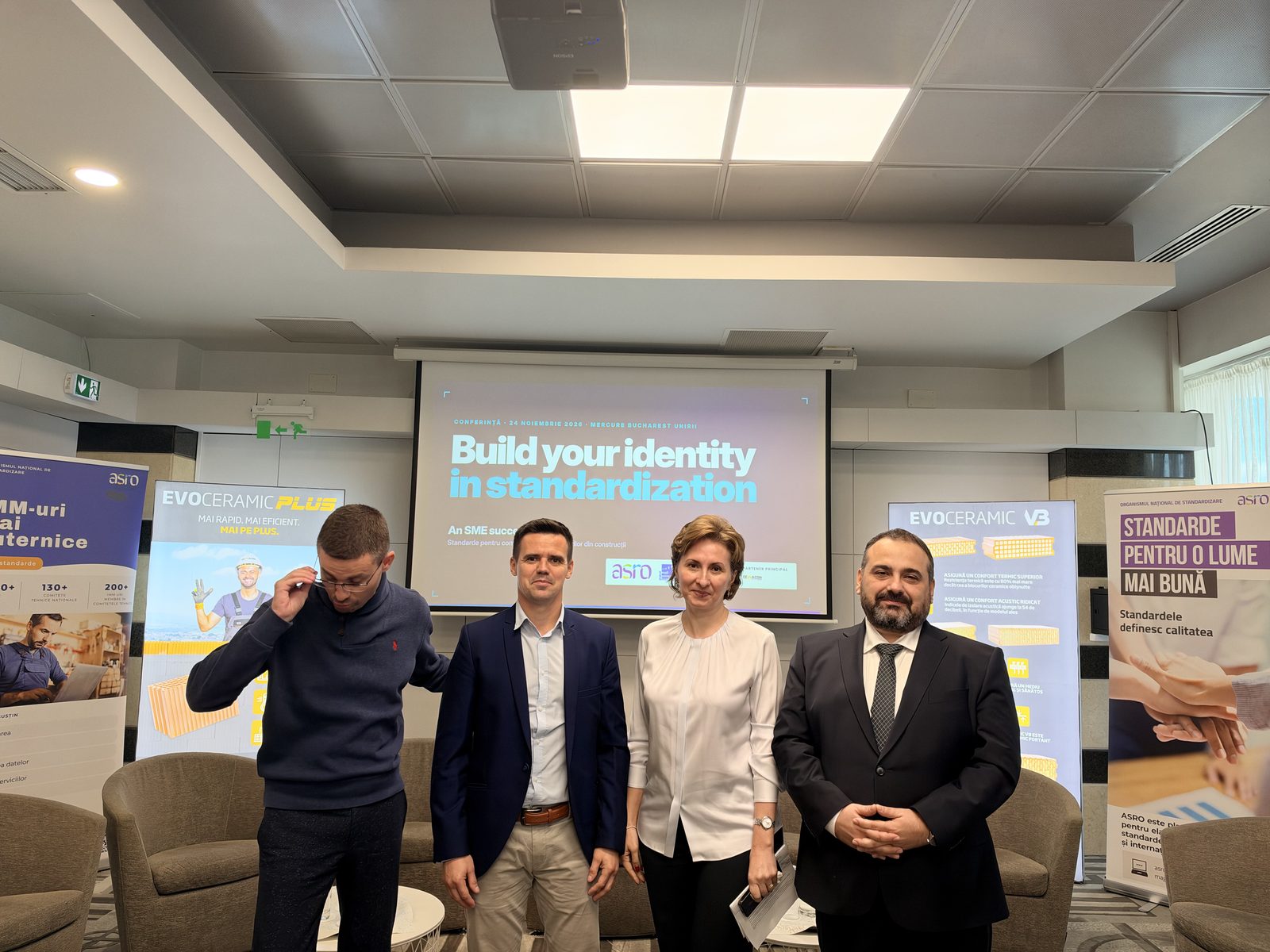
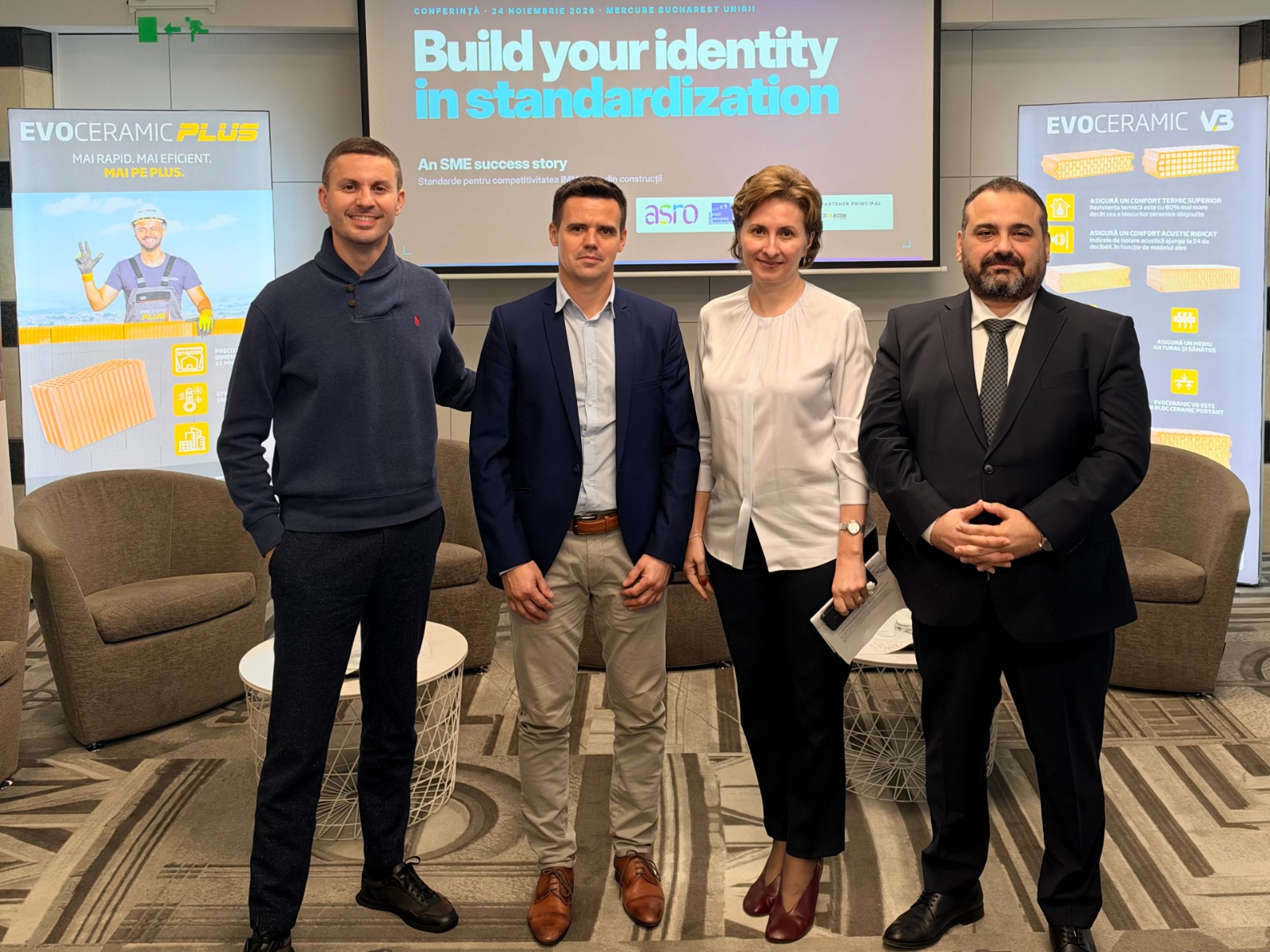
On 24 November 2026, ASRO held the conference “Build your identity in standardization. A SME success story” at Mercure Bucharest Unirii. The event was organised with IMM România and Small Business Standards (SBS), with CEMACON as main partner. Entrepreneurs, designers, public authorities and experts discussed the standards that are changing the construction sector. The shared message: the rules for the coming years are being written now. Construction SMEs have every reason to take part in developing them.
Opening: quality infrastructure starts with standardization
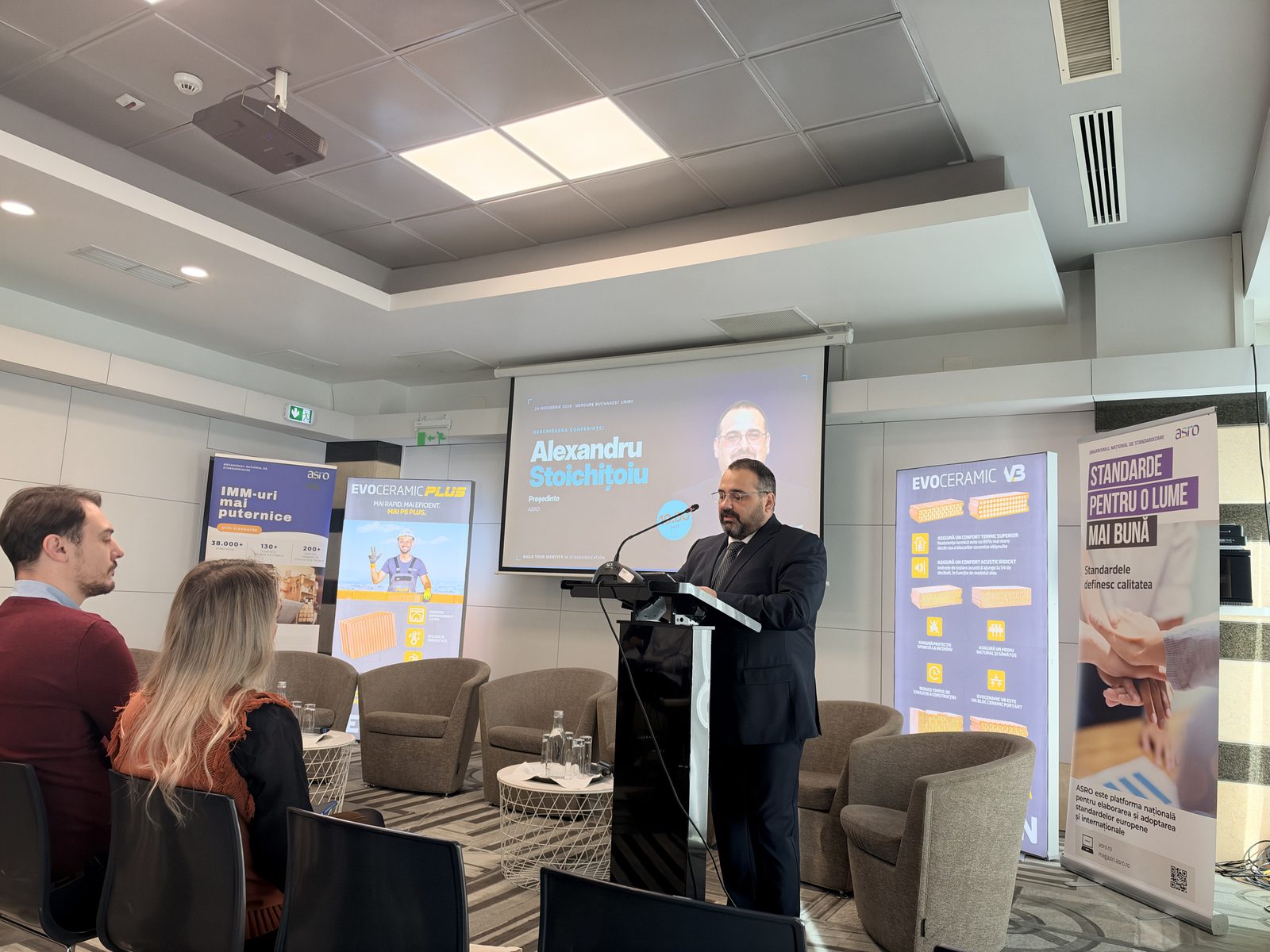
Alexandru Stoichițoiu, President of ASRO, opened the conference. He described quality infrastructure as being as important for the economy as transport infrastructure. Standardization, metrology, accreditation, conformity assessment and market surveillance together create the trust the market needs. It all starts with standardization. This is where businesses, authorities and consumers agree on the rules together.
The ASRO President called on Romania to contribute more to the development of standards, not only to adopt them. Until recently, mainly large companies had the resources to take part. New European legislation creates a more favourable context for SMEs. In construction, standards give all bidders the same rules of the game.
Florin Duma, First Vice-President of IMM România, delivered the organisation’s message. IMM România welcomed the involvement of SMEs in the conference. Small construction companies face challenges related to taxation, workforce and production costs. The standards they apply can help them increase productivity.
The voice of SMEs in European standardization
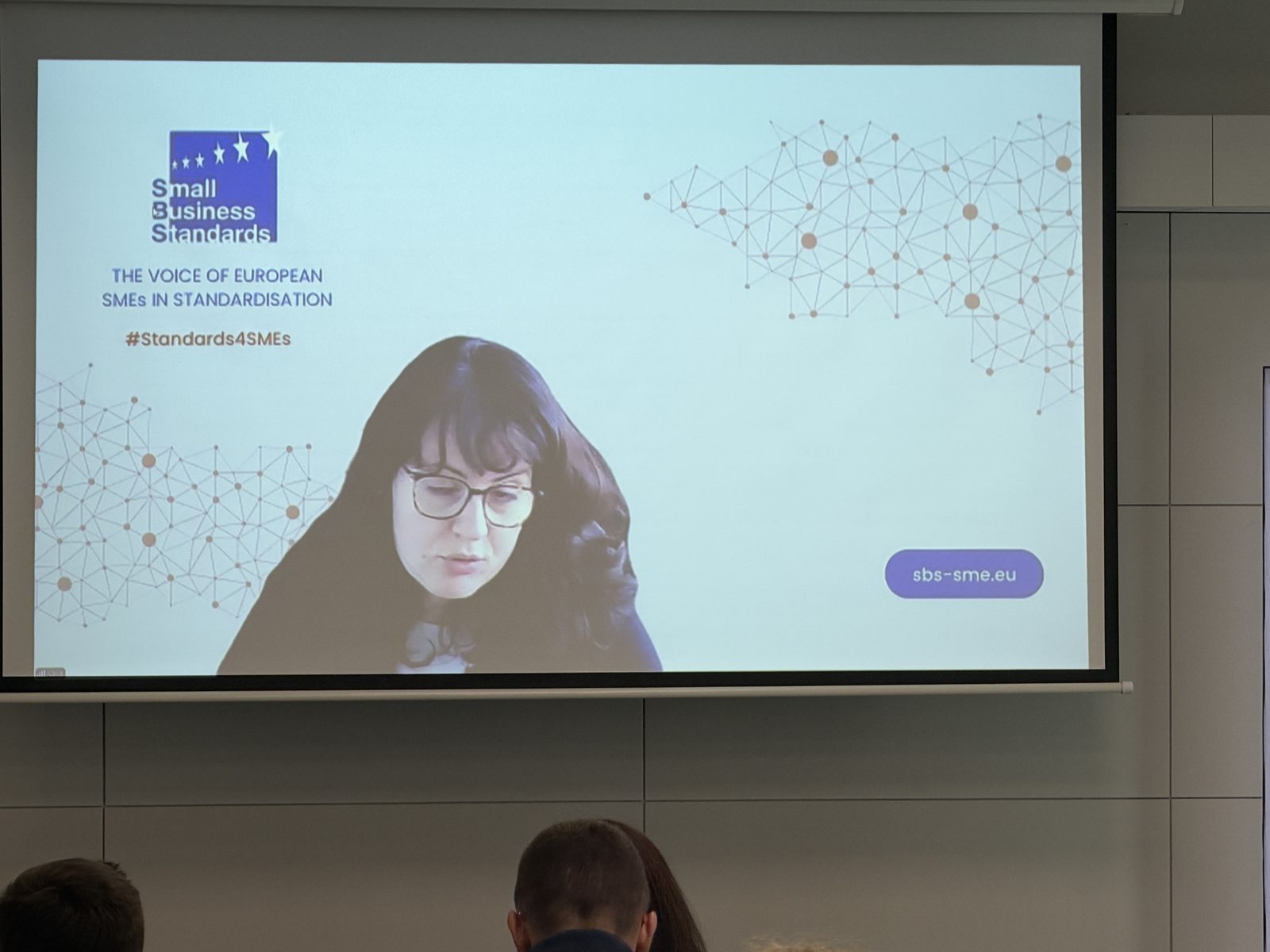
Evangelia Tsiala, Technical Officer and Expert Coordinator at SBS, joined online. She presented the role of Small Business Standards, the European association that brings SME experts into technical committees. Their question is always the same: can a small company actually apply this standard? In construction, SBS works on topics ranging from the Eurocodes to construction products. The association has also published a guide on implementing the new Construction Products Regulation (CPR).
SBS supports the European Commission’s proposal for a new regulation on standardization. The proposal aims for faster standards and free access to standards with legal effect. National standards bodies will also be required to involve SMEs.
Panel 1: CATUC, BIM and DPP, from law to practice
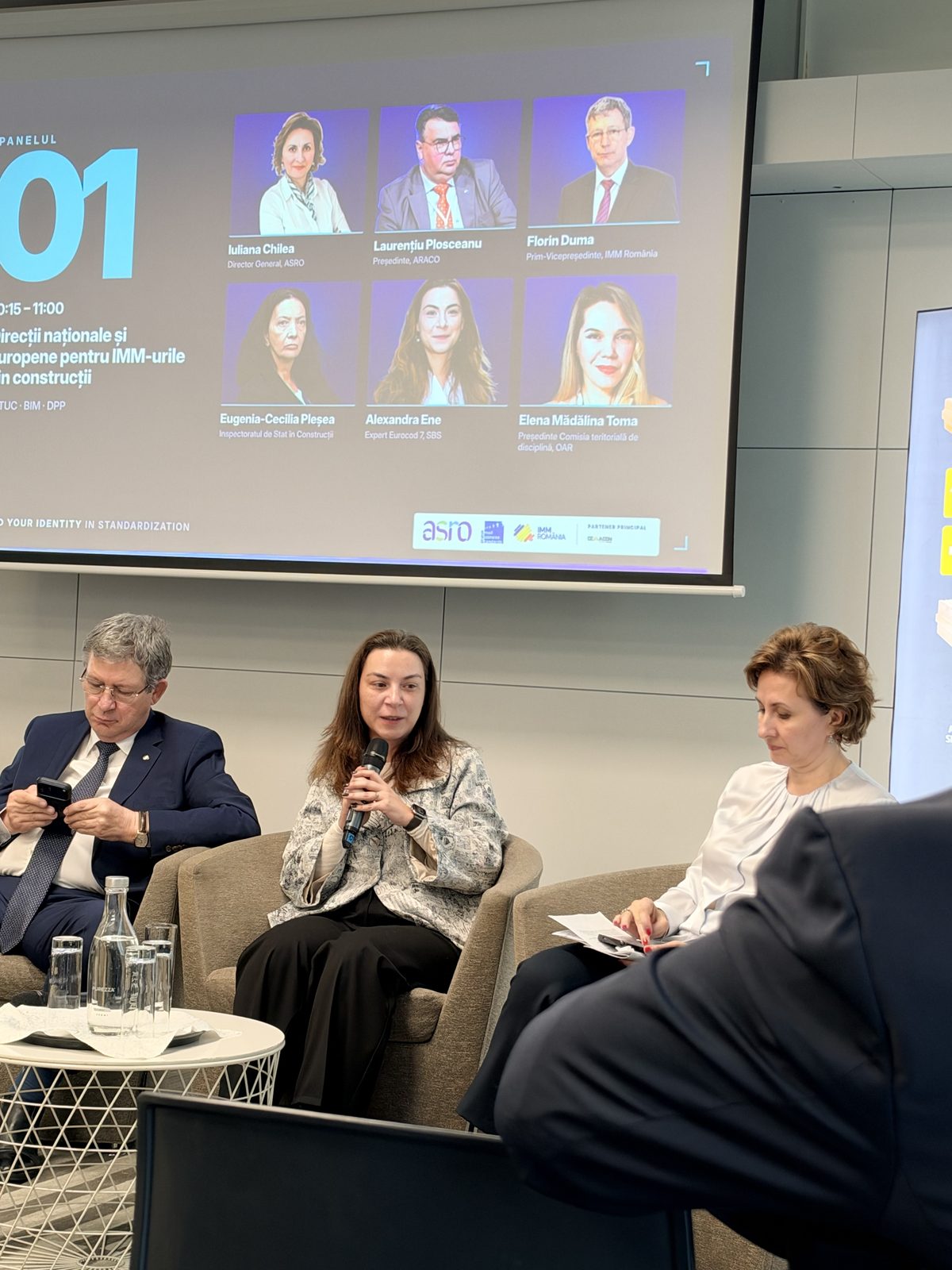
The first panel was moderated by Larisa Ellsberger, Project Manager at ASRO. It covered the national and European policy directions that are changing the work of construction companies. The discussion focused on three topics. The first was Romania’s new Code on spatial planning, urban planning and construction (CATUC). The other two were Building Information Modelling (BIM) and the Digital Product Passport (DPP).
Eugenia-Cecilia Pleșea, from the State Inspectorate for Construction, explained how CATUC applies. The Code does not distinguish between types of companies. It distinguishes between types and categories of construction works.
Elena Mădălina Toma, President of the Territorial Disciplinary Commission of the Order of Architects (Bucharest branch), spoke from the designers’ perspective. The new Code clarifies the role of each party, from designer to verifier and site supervisor. However, some interpretations still create bottlenecks between designers and authorities. One example is the new method for calculating land-use indicators.
Laurențiu Plosceanu, President of ARACO, described BIM as an evolution driven by clients. Romania has a BIM roadmap, with pilot projects planned for 2026–2028. His advice for SMEs: set clear objectives before buying software, train people and rely on professional associations.
Florin Duma highlighted the size of CATUC and the need for clear implementing rules. For BIM, he proposed partnerships between companies and dedicated funding programmes for SMEs.
The standards that connect CATUC, BIM and DPP
Iuliana Chilea, Director General of ASRO, linked the three topics through a data chain. The product comes with its digital passport. The data goes into the BIM model, and the model ends up in the building’s technical logbook. Standards make these links fit together:
- EN ISO 19650 for organising information on projects;
- IFC, the open format for BIM models;
- EN ISO 7817-1 for the level of information need of the model;
- eight European standards for the Digital Product Passport, adopted as Romanian standards;
- six of them already cited in the Official Journal of the European Union;
- product family rules under development: cement and binders by the end of 2027, doors and windows in 2028–2029;
- CEN standards for the Digital Building Logbook, due in 2028;
- EN ISO/IEC 17025 for competent laboratories and EN 15804 for comparable environmental declarations.
The ASRO Director General invited companies to join ASRO technical committees. There, draft standards can be reviewed and commented on years before they become mandatory.
Alexandra Ene, Eurocode 7 expert for SBS, brought the European perspective. The main difficulty for SMEs is the lack of resources to take part. Those who join the discussions understand the reasons behind each requirement much better. They can then explain the standards to those who were not involved.
Smart buildings and REGo_ETSI
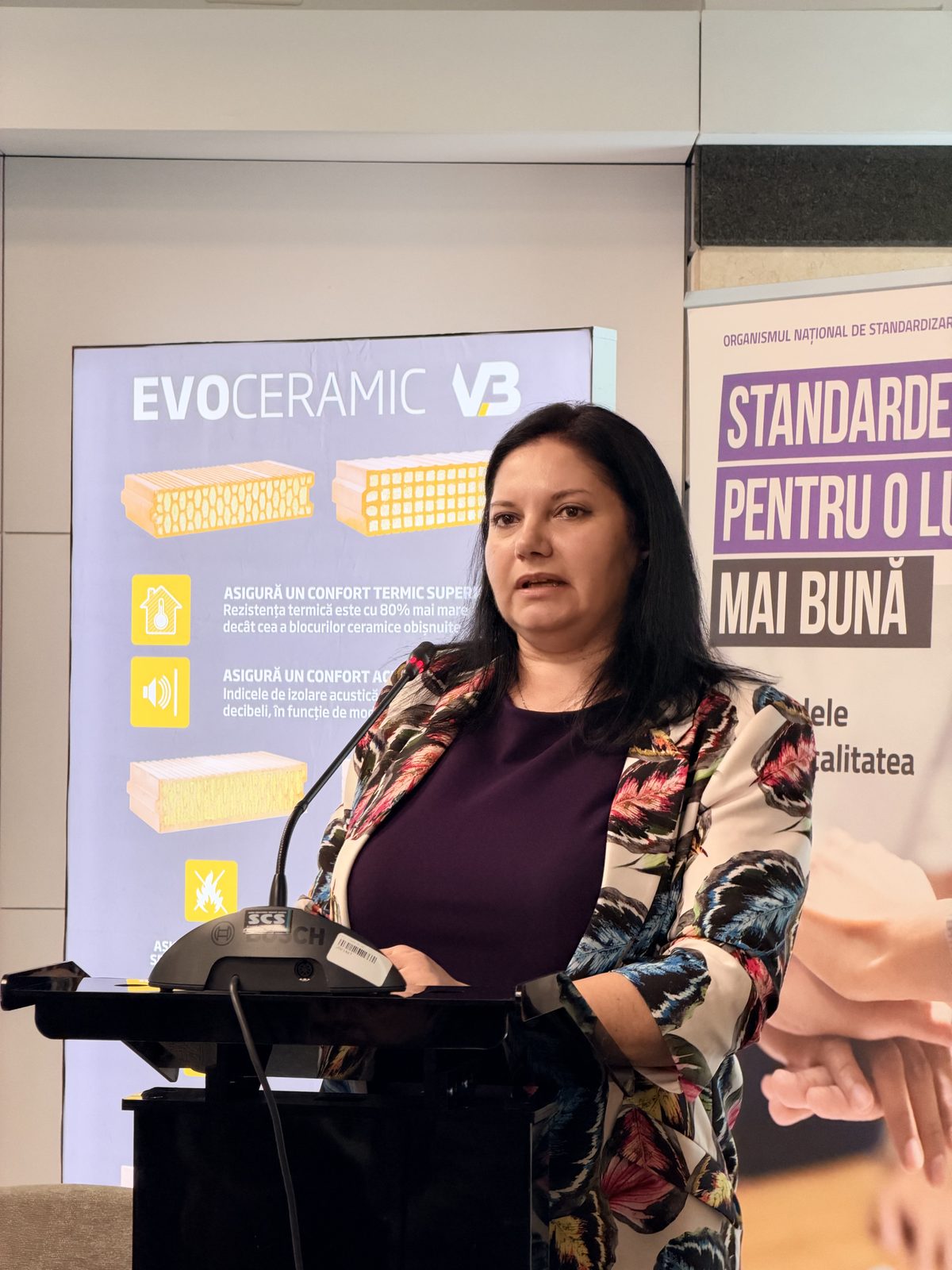
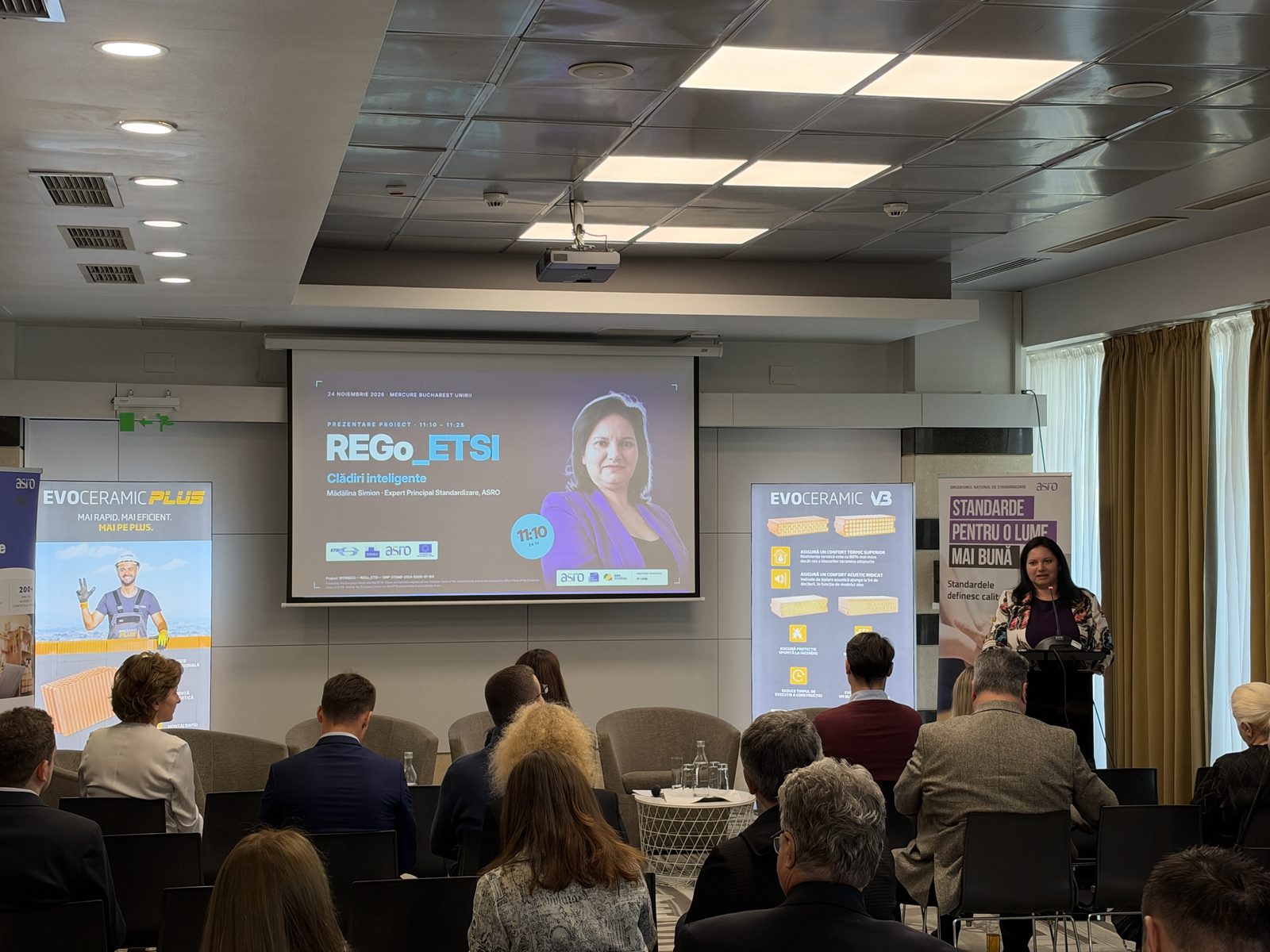
Mădălina Simion, Principal Standardization Expert at ASRO, presented the REGo_ETSI project. The 24-month project focuses on the European Telecommunications Standards Institute (ETSI). Through it, national standards bodies strengthen their participation in ETSI’s work.
The presentation covered six topics for smart buildings. The first were automation, communication between devices, electrical safety and electromagnetic compatibility. These were followed by the Internet of Things, cybersecurity and energy efficiency.
Examples included the SAREF ontology, with its extensions for buildings and energy, and the oneM2M specifications. The presentation also covered the cybersecurity requirements for radio equipment, applicable since August 2025. It also addressed the reporting obligations under the Cyber Resilience Act, applicable from September 2026.
For construction and installation SMEs, standards mean easier system integration and simpler proof of conformity. They also open the way to new services, such as energy consumption monitoring.
CEMACON: turning standards into trust
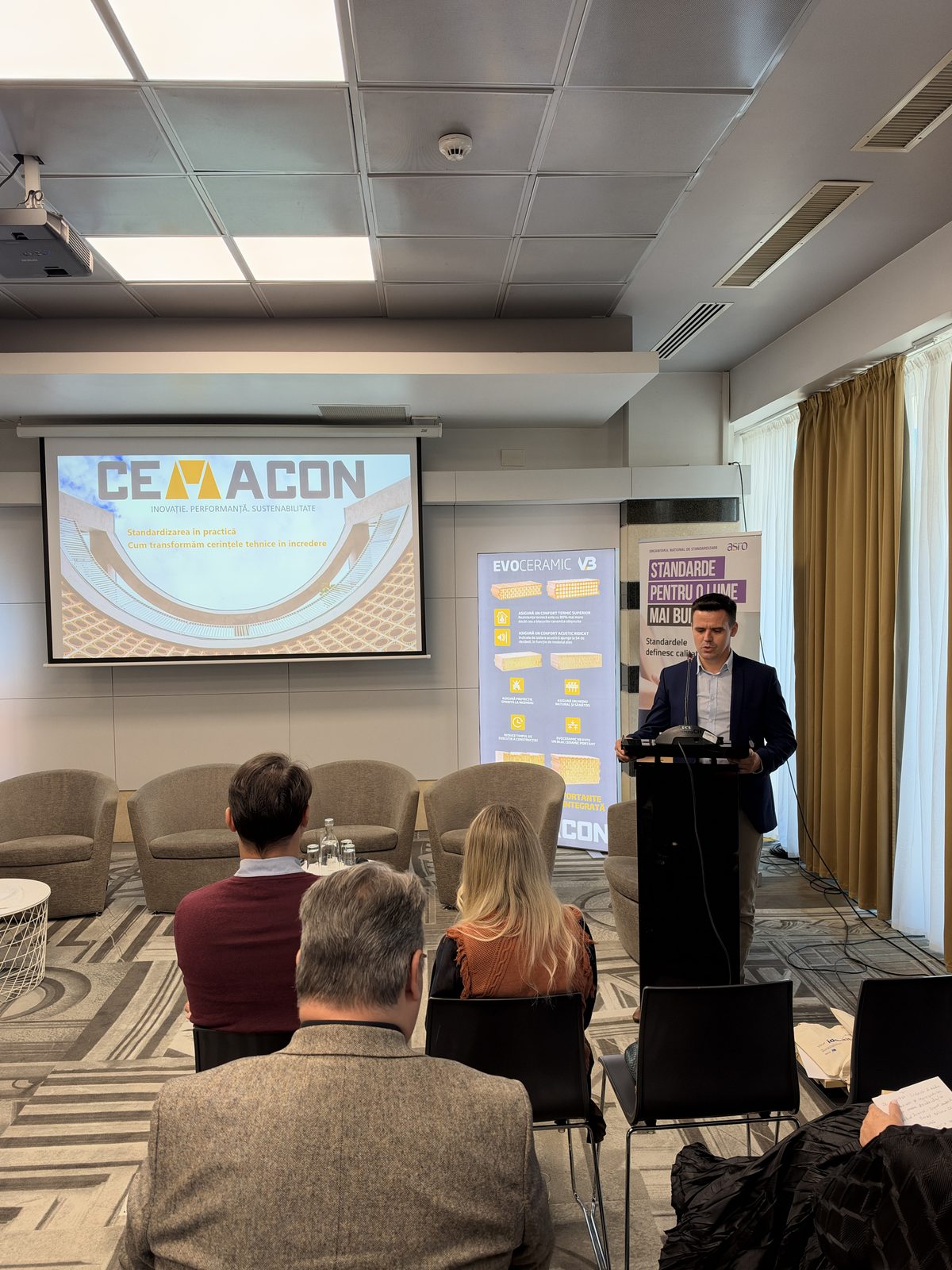
Tiberiu Isa, Quality Assurance and Laboratory Manager at CEMACON, showed how the company uses standards every day. Control starts with the clay in the quarry and continues throughout production. Laboratory tests then confirm the performance of the ceramic blocks. The results feed into the declaration of performance and the CE marking.
The aim of these checks is to prevent problems, not only to find them. His conclusion: CEMACON uses standards to build customer trust.
Panel 2: success stories
The second panel showed, through concrete examples, how standardization supports construction SMEs and their associations.
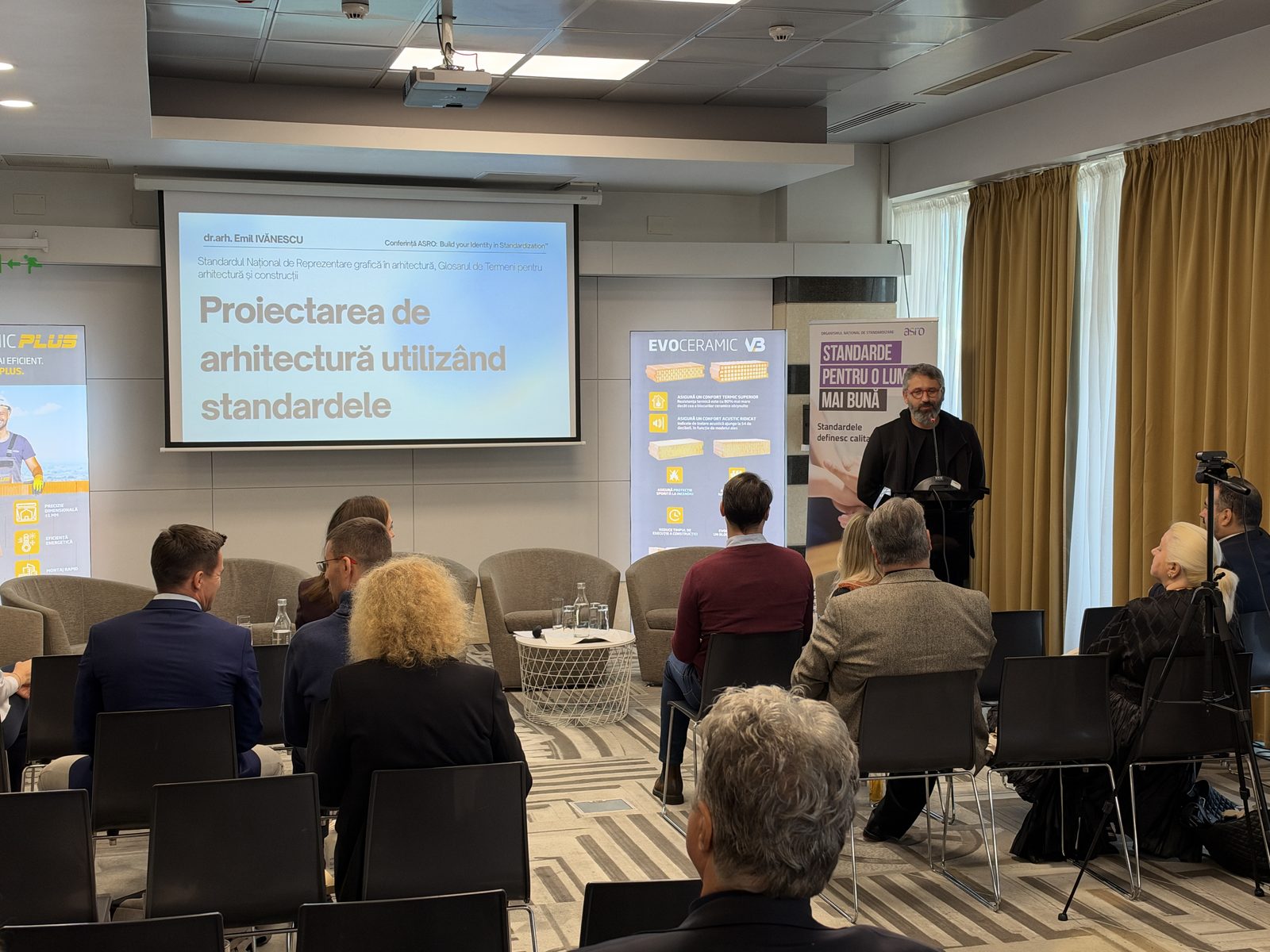
- Emil Ivănescu, Order of Architects of Romania, presented the first national standard for the graphic representation of architectural projects. The standard is being developed with ASRO and is close to public enquiry. The Order has also given architects access to standards and created a platform listing terms that block permitting;
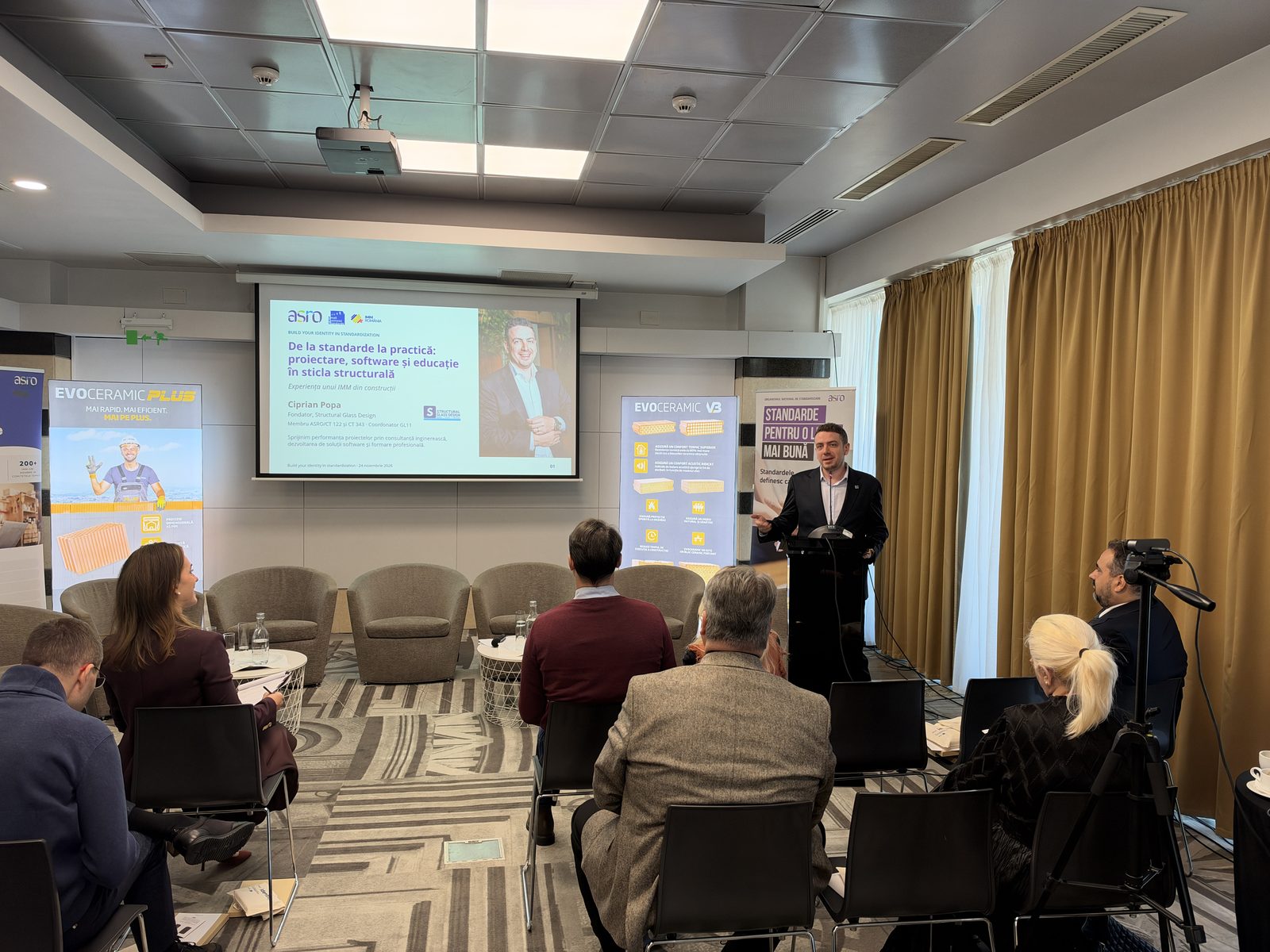
- Ciprian Popa, StructuralGlass Design, spoke about the European standards for glass structures, the future Eurocode 10. They helped him justify technical solutions to verifiers and contractors. One example is an award-winning project in Oradea;
- Rodica Lupu, Cluster TEC, explained how the logic of EN ISO 19650 has entered Romanian technical regulations. Together with technical universities, the cluster developed occupational standards for five BIM occupations. She also warned against BIM certifications without real accreditation;
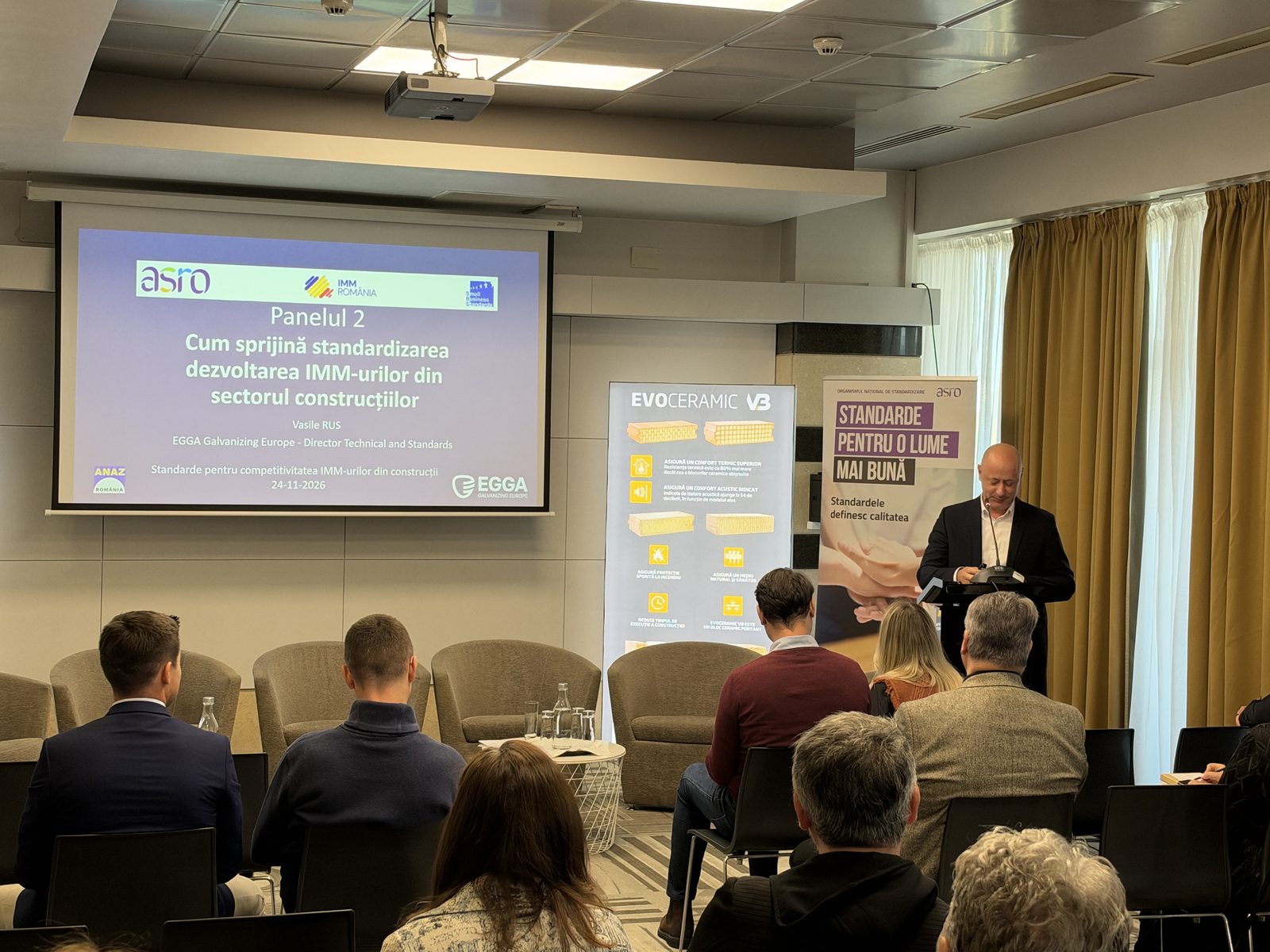
- Vasile Rus, ANAZ / EGGA, explained how the association involves its members in working groups. ANAZ supports the translation and fast adoption of hot-dip galvanizing standards and promotes EN ISO 1461;
- Cristian Onofrei, AICPS, showed how a small design firm uses information models and the EN ISO 19650 series. He stressed the role of associations in bringing all market players together.
Conclusions for construction SMEs
In his closing remarks, Alexandru Stoichițoiu spoke about the shortage of technical expertise in quality infrastructure. He invited market specialists to get involved in standardization, conformity assessment and accreditation. All components must work together, as in a transport network.
The transformation of the construction sector is already under way. Standards provide a common language for designers, contractors, manufacturers and authorities. Construction SMEs can shape the content of standards through ASRO technical committees, public enquiry and their professional associations.
“The law tells you what you have to deliver. Standards tell you in what format, and how you prove that what you deliver can be trusted. Standards are not developed in an office in Brussels. They are developed in technical committees, with experts from industry, public authorities and academia. The rules for your products and works are being written now. You will apply them in a few years anyway, so it is better to know them and influence them now. The door to ASRO technical committees is open to construction SMEs.”
Iuliana Chilea, Director General, ASRO
ASRO thanks its partners IMM România and Small Business Standards, its main partner CEMACON, all speakers and participants.
Companies interested in the work of ASRO technical committees can contact us at [email protected] or +40 21 316 32 96.
Photo gallery